
.png)
Property condition is one of the most consequential, and least understood, dimensions of real estate valuation. Whether you are an appraiser, a lender, an institutional investor, or a policymaker, understanding what appraisal condition ratings mean in practice is essential for making sound decisions.
This blog post explains the UAD condition rating scale from C1 to C6, how each rating is defined, how they compare to quality of construction ratings, and what AI-based condition data at national scale is revealing about the state of America's housing stock.
What Are UAD Condition Ratings?
UAD stands for Uniform Appraisal Dataset, a standardized framework established by Fannie Mae and Freddie Mac to bring consistency to residential appraisal reporting across the United States.
Within the UAD framework, every single-family property receives two separate standardized ratings:
- Condition Rating (C1–C6): Reflects the physical state and level of maintenance of the property.
- Quality of Construction Rating (Q1–Q6): Reflects the materials, craftsmanship, and design level of the property.
These are distinct assessments. A home can be built with high-quality materials (Q2) but be in poor physical condition (C5) due to years of neglect. Understanding the difference between these two dimensions is critical for accurate valuation.
The C1–C6 Appraisal Condition Scale: A Complete Guide
The condition rating scale runs from C1 (best condition) to C6 (worst condition). Here is what each rating means in practice.
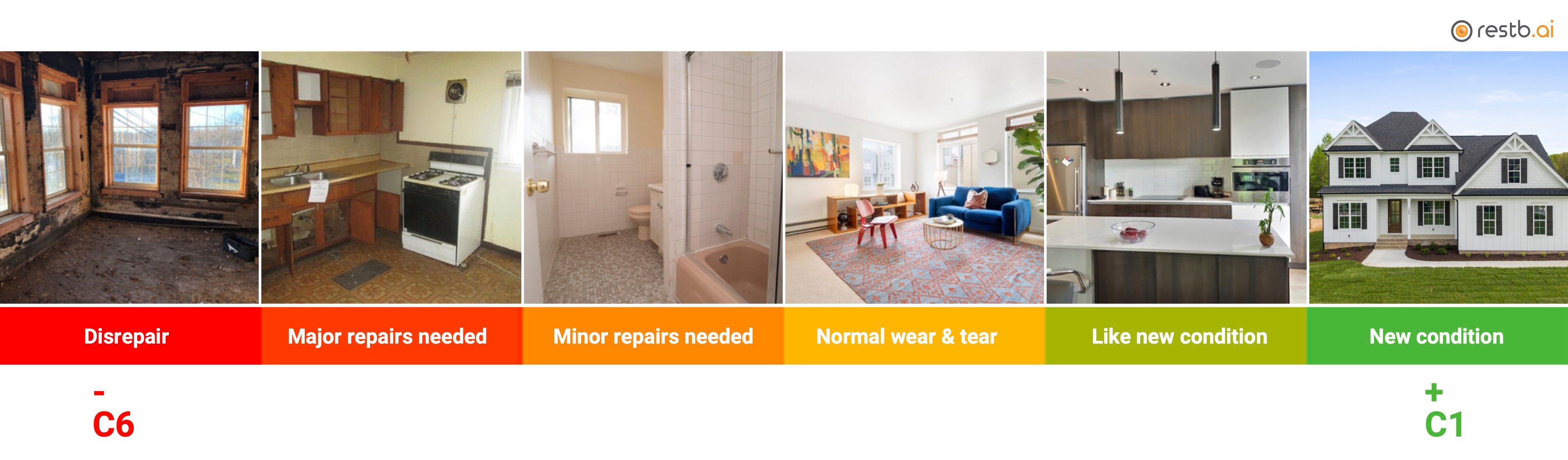
What Is a C1 Condition Rating?
A C1 appraisal condition rating indicates a property that has been very recently constructed and has not previously been occupied. All components are new, with no signs of physical depreciation. In practice, C1 ratings are rare and apply almost exclusively to brand-new, never-occupied homes.That’s the part most people miss. AI search is only as good as the data it can access. And today, much of the most valuable real estate data is not structured at all. It is sitting in an unstructured source of data like property photos.
What Is a C2 Condition Rating?
A C2 appraisal condition rating indicates a property with no deferred maintenance, little or no physical depreciation, and no required repairs. Most building components are either new or have been recently updated to a like-new condition. C2 properties are similar in condition to new construction, even if the home itself is not brand new.
What Is a C3 Condition Rating?
A C3 appraisal condition rating indicates a well-maintained property with limited physical depreciation due to normal wear and tear. Some components may have been updated or recently rehabilitated, but not every major building component needs to have been. The structure has been consistently well-maintained over time.
C3 is often considered the standard for a move-in ready home in good condition. Most owner-occupied homes in active, well-maintained neighborhoods fall into the C3 range.
What Is a C4 Condition Rating?
A C4 appraisal condition rating indicates a property with some minor deferred maintenance and physical deterioration due to normal wear and tear. The dwelling has been adequately maintained but requires only minimal repairs to building components, mechanical systems, and cosmetic elements. All major building components remain functionally adequate.
C4 is the most common condition rating for homes that have been lived in for several years without major renovation. The home is habitable and functional but shows its age.
Why C4 matters at scale: A recent study by AEI Housing Center, "Rehabilitating Housing Supply", combined internal transaction data from Amherst Holdings with AI-based property condition scores from Restb.ai and public assessor records, analyzing approximately 18 million residential listings nationwide. The research found that roughly 42% of homes acquired by large institutional investors fell within the C4 condition range, reflecting minor deferred maintenance and physical deterioration. On average, these homes required about $32,000 in rehabilitation spending to return to neighborhood-median condition.
AEI Figure — "Distribution of Restb.ai Property Condition at Acquisition by Amherst."
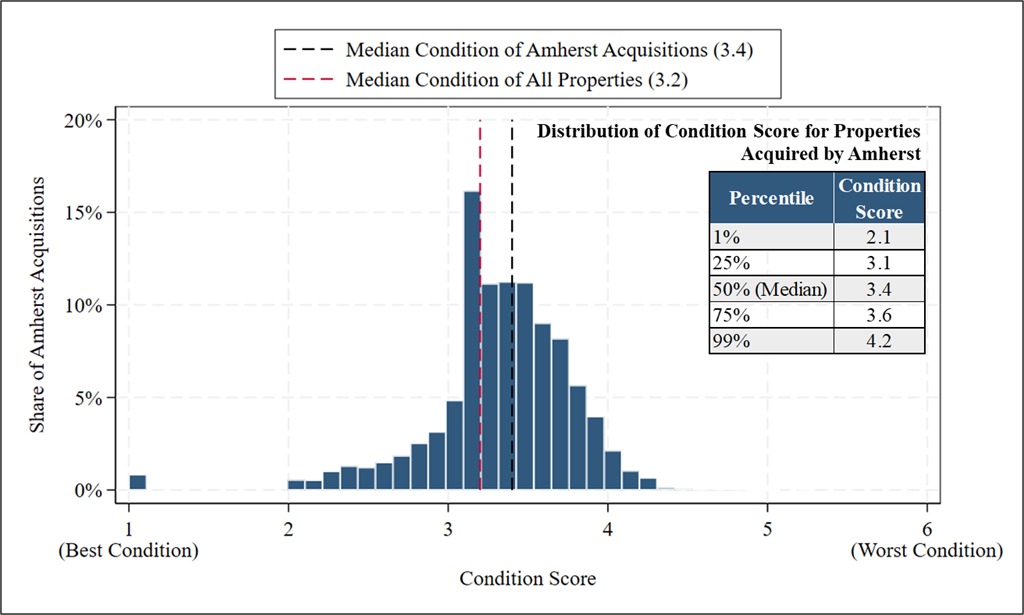
Notes: Based on approximately 9,400 Amherst MLS-acquired properties and over 12 million single-family homes in the public records data with a Restb.ai condition score. Condition scores follow the standard C1–C6 appraisal scale, where higher values indicate worse condition. Source: Amherst, Restb.ai, and AEI Housing Center.
What Is a C5 Condition Rating?
A C5 appraisal condition rating indicates a property with obvious deferred maintenance that is in need of some significant repairs. Some building components need repair, rehabilitation, or updating. The functional utility and overall livability of the home are somewhat diminished due to condition, but the dwelling remains usable and functional as a residence.
C5 homes are still livable but require meaningful investment. For many first-time buyers with limited savings and restricted access to renovation financing, a C5 property presents a significant barrier to purchase.
What Is a C6 Condition Rating?
A C6 appraisal condition rating indicates a property with substantial damage or deferred maintenance, with deficiencies or defects severe enough to affect the safety, soundness, or structural integrity of the improvements.
In practical terms, a C6 home is unsafe or uninhabitable, and the rehabilitation investment required is substantial. Standard mortgage financing is typically unavailable for C6 properties.
The vacancy connection: The same AEI research using Restb.ai property condition data across more than 10 million properties found a sharp increase in vacancy rates as condition scores approached and exceeded C5–C6 levels. Homes in the poorest condition were disproportionately likely to be vacant, effectively removing them from the usable housing stock. The findings have significant implications for how policymakers think about housing supply.
AEI Figure — "Public Records Assessor Vacancy Rates by Restb.ai Property Condition."
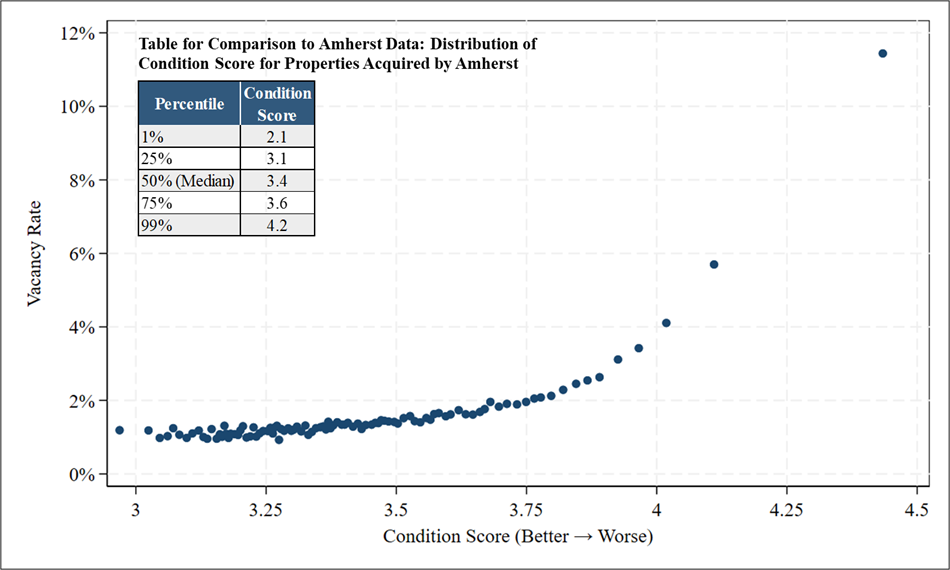
Notes: The figure shows the relationship between property condition and vacancy rates. Higher condition scores indicate worse physical condition. Vacancy rates increase steadily with condition, with a sharper rise among properties in poor condition (above approximately 3.5). This pattern suggests that homes in poorer condition are more likely to be underutilized or removed from the active housing stock. The sample includes approximately 12.7 million properties, using the most recent listing data aligned with assessor records. Properties are binned into 100 groups. Source: First American, Restb.ai, and AEI Housing Center.
Condition Ratings vs. Quality of Construction Ratings: What Is the Difference?
One of the most common points of confusion in appraisal reporting is the distinction between condition ratings (C1–C6) and quality of construction ratings (Q1–Q6).
Condition ratings measure the current physical state of the property, how well it has been maintained, what repairs are needed, and how much deterioration has occurred over time. Condition can change. A C2 home can become a C4 home over a decade of deferred maintenance.
Quality of construction ratings measure the inherent characteristics of the home's design and materials, the level of craftsmanship, the quality of finishes, and the architectural complexity. Quality is largely fixed at the time of construction and does not change with maintenance or renovation.
💡 A practical example: a well-maintained 1950s ranch house built with standard materials might be rated Q4 (adequate quality) and C3 (well-maintained). A poorly maintained luxury home might be rated Q2 (high quality) and C5 (significant deferred maintenance).
How AI Scores Condition and Quality, Room by Room
Traditionally, appraisers assessed condition and quality as a single overall judgment, applied to the whole property at once. AI-based condition scoring goes further, breaking the assessment down by area of the home, analyzing kitchen, bathroom, interior, and exterior photos separately, and then aggregating them into an overall score.
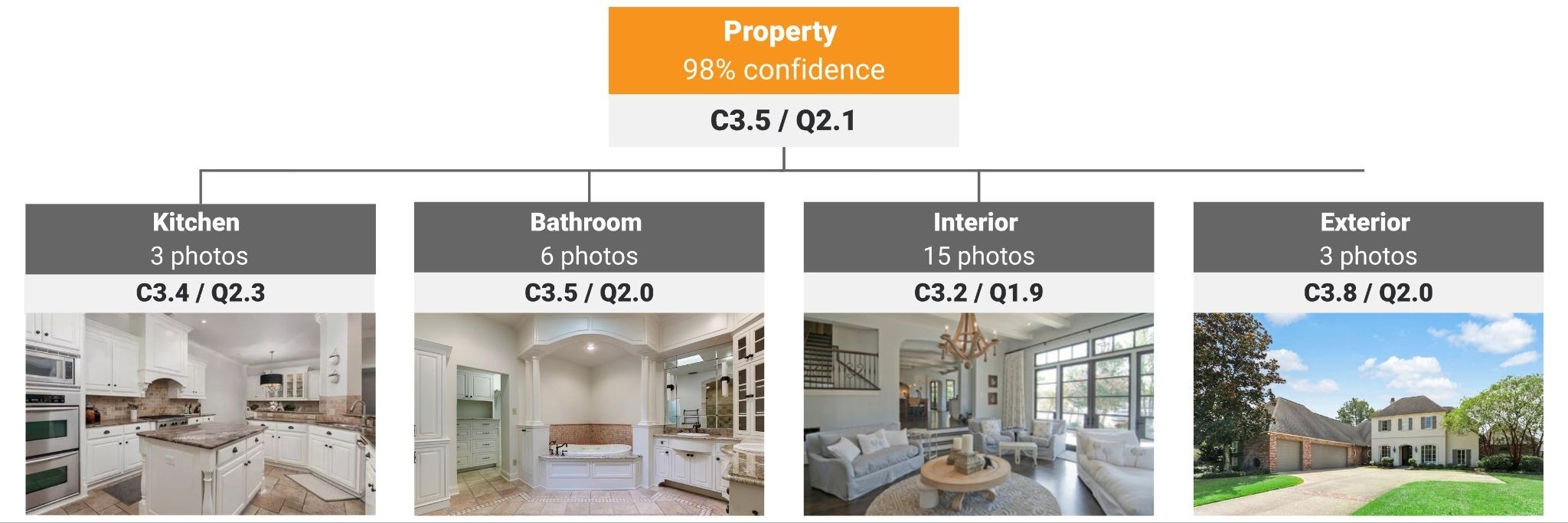
This granularity matters for two reasons. First, it makes the assessment more accurate, a home with a recently renovated kitchen but an aging exterior will score differently than one with uniform wear throughout, even if their overall condition looks similar on the surface. Second, it creates a consistent, reproducible record that does not depend on a single appraiser's judgment on a single day.
With the GSEs' appraisal modernization efforts and the new UAD requiring condition and quality scores to be broken out into interior and exterior components, this level of detail is becoming not just useful, it is becoming necessary.
This capability is already being applied in professional valuation contexts. Stewart Valuation Intelligence integrated Restb.ai's AI-based condition and quality scoring into their review process, bringing this level of consistency and granularity to appraisal review at scale. The integration allows reviewers to compare AI-generated scores against appraiser ratings across every file, flagging discrepancies automatically rather than relying on manual spot-checks.
➡️ Read the full case study to see how it works in practice.
FAQ: Common Questions About UAD Condition Ratings
What is the most common UAD condition rating?
For actively marketed and owner-occupied homes, C3 and C4 are the most common condition ratings. C3 indicates a well-maintained property with normal wear and tear. C4 indicates adequate maintenance with some minor deferred repairs. Together, these two ratings cover the majority of homes in the active residential market.
What is the difference between C3 and C4 appraisal condition?
The key distinction is the degree of maintenance and the presence of deferred repairs. A C3 property is well-maintained with limited depreciation due to normal wear and tear, it is in good condition. A C4 property has been adequately maintained but shows some minor deferred maintenance and physical deterioration, it is in acceptable condition but requires attention. In practical terms, a C3 home is move-in ready, while a C4 home may benefit from cosmetic or minor mechanical updates.
Can condition ratings be improved?
Yes. Condition ratings reflect the current physical state of a property and can change over time. A C5 or C4 property that undergoes significant rehabilitation can achieve a C3 or even C2 rating after renovation.
This is precisely what the AEI research on institutional investor rehabilitation activity documented, using Restb.ai condition data to track condition scores before and after renovation across hundreds of properties. The study found that homes acquired at condition scores around 3.4–3.6 (mid-C4 range) were brought back to approximately 3.0 (C3 range) following rehabilitation investment.
AEI Figure — "Relationship Between Amherst Rehabilitation Spending and Condition Improvement: Binned Scatterplot”
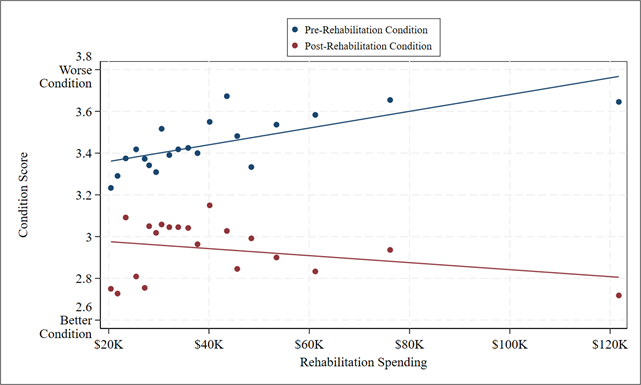
Notes: The figure compares property condition before and after rehabilitation as a function of rehabilitation spending. Higher values indicate worse condition. Post-rehabilitation condition is consistently lower than pre-rehabilitation condition, indicating systematic improvement. Properties with higher initial repair needs receive greater investment and exhibit larger improvements. The sample is limited to properties with rehabilitation spending between $20,000 and $200,000. Data are for 202 homes. Source: Amherst, Restb.ai, and AEI Housing Center.
For more information on how Restb.ai applies AI to property condition assessment at scale, visit restb.ai/solutions/property-condition.
Full AEI research report:"Rehabilitating Housing Supply: Evidence from an Institutional Investor’s Acquisition, Renovation, and Market Position"


comments